
Understanding Gemstone Clarity Types
Gemstones are categorized into three main clarity types based on their natural characteristics. This classification helps set realistic expectations when evaluating a stone's quality and value.
Type I – Typically Eye-Clean
These gems are usually found with very few or no visible inclusions. Common examples include Aquamarine, Blue Topaz, and Citrine.
Clarity Range:
They are graded on a scale from VVS (Very, Very Slightly Included) to I (Included), similar to diamonds. Stones in the VVS to VS range are routinely expected to be eye-clean.
Type II – Usually Included
Stones in this category commonly form with some minor inclusions. This group includes Sapphire, Ruby, and Garnet.
Clarity Range:
They are most frequently found in the VS (Very Slightly Included) to SI (Slightly Included) clarity grades. However, exceptional, eye-clean specimens do occur and are highly valued.
Type III – Almost Always Included
These gems are renowned for their pronounced inclusions, which are considered a hallmark of their natural identity. The most classic example is the Emerald, along with certain Tourmalines and Demantoid Garnet.
Clarity Range:
For these gems, a grade of SI (Slightly Included) is often the norm rather than a flaw. In fact, an emerald with a "clean" SI grade can be considered a high-quality, desirable stone. Finding a Type III gem with VVS clarity is exceptionally rare.
Emerald Special Consideration
For emeralds, the term "no eye-visible inclusions" is commonly used, as they are rarely completely clean. This reflects the natural characteristics of emeralds, where some inclusions are expected and accepted.
Types and Degrees of Clarity in Gems
Clarity is one of the most important factors in determining a gemstone's value. This guide explains the different clarity types and grades used in gemology.
Type 1 Gemstones (Simplified)

Type 1 - Eye-clean (VVS1, VVS2, VS1, VS2)
No eye-visible inclusions.

Type 1 - Slightly Included (SI1, SI2)
Minor inclusions may be eye-visible upon close inspection.

Type 1 - Moderately Included (I1)
Obvious inclusions, easily visible to the unaided eye.

Type 1 - Heavily Included (I2, I3)
Obvious and numerous inclusions that severely affect the stone's appearance and/or durability.
Type 2 Gemstones (Simplified)

Type 2 - Eye-clean (VVS1, VVS2, VS1, VS2, SI1)
Stones in these grades are typically free of eye-visible inclusions. SI1 is a borderline clarity grade; however, for Type II stones, many SI1 specimens remain eye-clean.

Type 2 - Slightly Included (SI2)
Inclusions are generally noticeable to the unaided eye upon close examination.

Type 2 - Moderately Included (I1, I2)
Obvious inclusions, easily visible and potentially affecting brilliance and overall appearance.

Type 2 - Heavily Included (I3)
Numerous and/or significant inclusions, significantly reducing clarity, brilliance and, in some cases, durability.
Type 3 Gemstones (Simplified)

Type 3 - Eye-clean (VVS1, VVS2, VS1)
Exceptional Rarity. Stones of the highest clarity grade, free of eye-visible inclusions. Command a significant price premium.

Type 3 - Slightly Included (VS2, SI1)
Inclusions are clearly visible at 10x magnification and are visible to the naked eye.

Type 3 - Moderately Included (SI2, I1)
Good / Standard Quality. Noticeable inclusions, yet the stone retains an attractive overall appearance and good durability. For emeralds, this often represents a commercially accessible and popular choice.

Type 3 - Heavily Included (I2, I3)
Obvious flaws. Numerous or significant inclusions that noticeably compromise the stone's transparency, brilliance, and/or stability.
Type 1 Gemstones

Type 1 - VVS1
The smallest inclusions in the form of insignificant points, which range from extremely hard to see to very hard to see. These points are very difficult to find.

Type 1 - VVS2
The smallest inclusions in the form of insignificant points, which range from extremely hard to see to very hard to see. These points are very difficult to find from the site side, but can be found from the pavilion side.

Type 1 - VS1
These are usually pure eye stones. They have minor inclusions visible to the naked eye or under magnification. It is not difficult to find inclusions under magnification.

Type 1 - VS2
These are usually pure eye stones. They have minor inclusions visible to the naked eye or under magnification. It is not difficult to find inclusions under magnification. Clouds and small cracks can be detected.

Type 1 - SI1
Inclusions are visible at 10x magnification, but are not always visible to the naked eye.

Type 1 - SI2
Inclusions are clearly visible at 10x magnification, but are not always visible to the naked eye.

Type 1 - I1
Inclusions that are easy to see with the naked eye. Single large inclusions. Inclusions affect the appearance and durability of the gem.

Type 1 - I2
Inclusions that are easy to see with the naked eye. Half or one third filled with inclusions. Inclusions affect the appearance and durability of the gem.
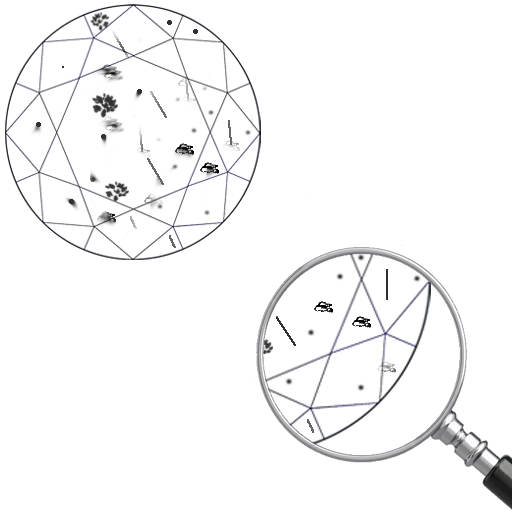
Type 1 - I3
Inclusions that are easy to see with the naked eye. The stone is all filled with inclusions. Inclusions affect the appearance and durability of the gem.
Type 2 Gemstones

Type 2 - VVS1
These are usually pure eye stones. They have minor inclusions visible to the naked eye or under magnification. It is not difficult to find inclusions under magnification. No inclusions are visible from the site side.

Type 2 - VVS2
These are usually pure eye stones. They have minor inclusions visible to the naked eye or under magnification. It is not difficult to find inclusions under magnification.
Type 3 Gemstones

Type 3 - VVS
Inclusions are visible at 10x magnification, but are not always visible to the naked eye.

Type 3 - VS
Inclusions are clearly visible at 10x magnification and are visible to the naked eye.