
Gemstone Cut Characteristics
The cut of a gemstone is a critical factor that greatly influences its brilliance, fire, and overall beauty. This guide explains the different cut types and their characteristics.
Gemstone Cut Types
Cut Characteristics
Assessing the Cut of Gemstones
The cut of a gemstone is a critical factor that greatly influences its brilliance, fire, and overall beauty. A well-cut gem will maximize light return, enhancing its visual appeal. When evaluating the cut of a gem, pay close attention to the following:
Key Aspects of Gem Cut Evaluation
- Facet Alignment: Examine the precision with which the facets meet, especially at the culet (the point at the bottom of the gem). The culet should form a sharp, well-defined point. Avoid stones where the culet has been flattened or polished into a small facet, as this is detracts from brilliance.. A sharp point is ideal, unless the specific cut style requires a different configuration.
- Symmetry: For round brilliant cuts, when viewed from above, you should see two squares of equal size, sharing a common center, with one rotated 90 degrees relative to the other. When inspecting other shapes, look for consistent symmetry throughout the gemstone.
- Girdle: The girdle, the narrow band around the circumference of the gem, should be neither too thin nor too thick. An overly thin girdle can make the stone prone to chipping, while an overly thick girdle adds unnecessary weight without enhancing appearance.
- Visual Size and Cut Proportions: A deeply cut gem will appear smaller face-up, while an overly shallow cut will make it seem larger for the same carat weight but often at the expense of brilliance. Optimal cut proportions are crucial for maximizing both brilliance and perceived size.
- Polish Quality: Examine the surface of the facets under magnification. High-quality polish should be smooth and mirror-like without visible polishing lines, scratches, or burn marks that can scatter light and reduce brilliance.
- Light Performance: Observe how light interacts with the stone. A well-cut gem should exhibit strong brilliance (white light return), fire (colored light dispersion), and scintillation (sparkle when moved). Rotate the gem to check for consistent performance from all angles.
- Window Effect: A "window" occurs when you look through the center of the gem and see a transparent, hollow area rather than light reflecting back. This indicates light leakage and poor cut proportions. A well-cut gem should minimize or eliminate visible windows.
- Extinction: Check for dark areas that appear when the gem is tilted. Some extinction is normal, but excessive dark areas indicate poor light return and suboptimal cutting.
- Chips and Damage: Look for any chips, especially those that reach the surface (particularly on the face-up side). Surface-reaching chips can dramatically decrease a gem's value and durability.
- Ideal Height Proportions: The height of the gem should ideally be approximately 70% of its diameter or width for optimal light performance, though this varies by gem type and cut style.
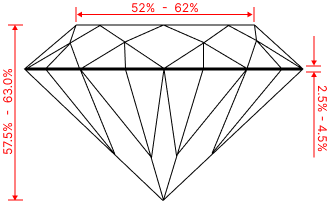
Ideal cut. In this type of faceting, light entering the gemstone is internally reflected by the pavilion facets and exits through the crown. The result is a brilliant, 'live' gemstone.
Examples:
The effect of proper proportions on light movement: a comparison between a well-cut gemstone and stones with either inadequate or excessive depth (height).
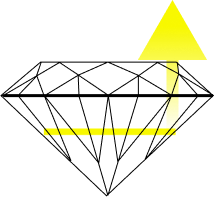
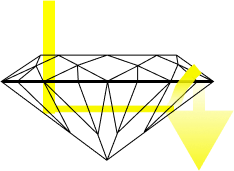
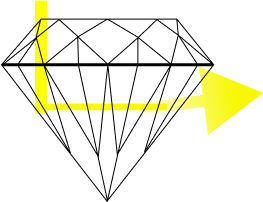
It's important to examine both the proportions and the craftsmanship of the cut to fully understand its impact on the overall appearance of the gem. Many rare and precious gems are often cut poorly in an attempt to retain as much weight as possible. This can diminish the gem's brilliance and perfection, which often compromises the inherent beauty of the gemstone in favor of maximizing the price per carat.
The Reality of Gem Cutting
It's disheartening when gems are sacrificed for weight retention, reducing their beauty and optimal light performance. We believe that an excellent cut enhances a gem's inherent beauty and value, far more than weight alone. We always advise choosing quality over weight.
Proper assessment of a gem's cut helps to determine a fair price per carat and also ensures that the inherent potential of the gemstone is realized. Ignoring the quality of cut when evaluating colored gems can significantly diminish a gem's overall appeal and value.